A spike in an electricity “capacity auction” meant that the supply price for Ameren Illinois increased significantly on June 1. Ameren estimated that this increased the average monthly bills of a typical residential customer by 18 percent to 22 percent, or roughly $38 to $46 per month, over the summer. Thankfully, Ameren’s price did go down significantly, as of Oct. 1. Read CUB’s Q&A and visit CUBHelpCenter.com for more information.
What happened?
In April, the power grid operator known as the Midcontinent Independent System Operator (MISO) announced the results of its latest capacity auction (technically called the “Planning Resource Auction”), covering the 12-month period from June 2025 through May 2026. The auction is how the grid operator secures reserve power in its region, which includes all or parts of 15 states from the upper Midwest through Ameren Illinois’ territory in central and southern Illinois and down to Louisiana. (MISO territory also includes the Canadian province of Manitoba.)
In the latest auction, the summer capacity price skyrocketed from $30 per Megawatt-day in 2024 to $666.50 per MW-day this year–a 22-fold increase. MISO’s capacity prices are seasonal, and while they are still elevated compared with the year before for the fall, winter and spring seasons, they do drop significantly after the summer. Below are the seasonal prices from the latest auction (Ameren Illinois is located in MISO’s Zone 4):
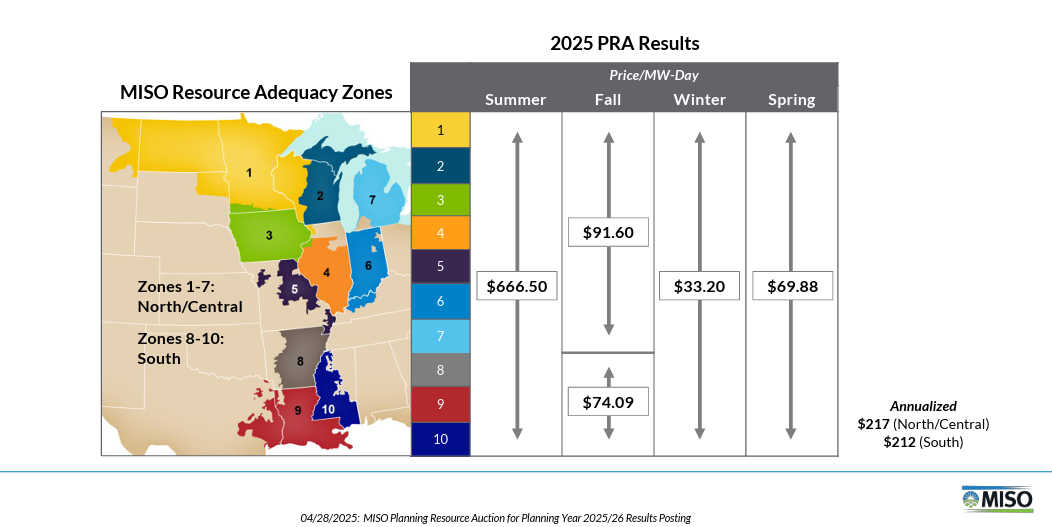
Click the image to see MISO’s full report on the capacity auction.
What exactly are capacity costs?
Not only do you pay for the power you use now, but you also pay for power you could use in the future. Capacity refers to extra payments consumers give power plant operators for the commitment to have enough reserve electricity available if demand suddenly spikes. (Think of a hot summer afternoon, when everyone blasts the air conditioning.)
Where does a capacity price increase appear on my bill?
An increase in capacity prices will affect the supply section of your Ameren bill. For most customers, the capacity cost is one component of Ameren’s per-kilowatt-hour (kWh) supply price. On average, capacity takes up roughly 20 percent of the supply price.
(While most customers don’t see capacity costs as a separate line item, participants in Ameren’s Power Smart Pricing program–which charges you a supply price that can change hourly–do see a capacity line item on their bills.)
How much will an increase in capacity costs increase Ameren bills?
Ameren’s electricity supply rate, also known as the “price to compare,” increased by about 50 percent, to 12.18 cents per kilowatt-hour (kWh), from June through September 2025. Ameren estimated that this higher rate, which includes the supply price, a transmission charge and a “supply cost adjustment,” increased summer power bills by an average of 18 percent to 22 percent, or $37.62 to $45.98 per month for the typical customer (10,000 kWh a year).
In October, capacity prices came down from their summer high, and Ameren’s new supply price, for October 2025 through May 2026, was significantly lower:
- 8.402¢ per kilowatt-hour (kWh) for up to 800 kWh of usage.
- 7.483¢ per kWh for all electricity usage beyond 800 kWh.
The summer price spike had a significant impact on Ameren customers. Unlike with PJM’s capacity market, MISO does not require participation from power plants. That’s because most utilities in MISO are “vertically integrated,” which means they generate their own electricity and deliver it to their customers at supply and delivery rates set by their state. Such utilities also supply or secure much of their capacity separate from the auction, and only rely on MISO if they have a shortfall. Ameren Illinois does not generate its own power and relies more than other utilities on MISO’s auction to secure its capacity needs.
So who made money off the price spike?
Power generators–large corporations that own power plants (mostly fossil fuel plants) and sell power to utilities like Ameren–made big profits. Ameren Illinois, the utility, is not making money off this price spike. The utility passes supply costs–including capacity payments–onto consumers with no markup.
(Note: Ameren does make money off another part of the bill–the delivery charges–and CUB challenges the utility’s proposed delivery rate hikes before state regulators. However, this supply price spike has nothing to do with Ameren’s delivery rate hikes.)
Why did this happen?
No doubt, increased demand fueled by data centers is part of the challenge. But the main driver of the price spike was policy shortcomings by MISO. A summary of the root causes of the price spike:
Anti-consumer market rules. Perhaps the biggest factor in the price spike was MISO’s new pricing methodology, called the Reliability-Based Demand Curve (RBDC). The grid operator used the RBDC for the first time in this auction, with the intention of giving better price signals that would incentivize developers to build more power plants. But consumer advocates raised deep concerns that the new method unacceptably compromised affordability. Douglas Jester, a clean energy policy expert, said the RBDC allowed MISO to overbuy capacity above minimum reliability levels, increasing costs. (MISO actually touted the RBDC for buying extra capacity and reducing the per MW-day summer price–but the price was lowered to $666.50, which is hardly a deal when the capacity cost was $30 last summer.) Also, the lucrative prices may incentivize generators to delay retiring dirty, outdated power plants.
Interconnection delays. The problem isn’t as severe as with the northern Illinois grid operator, PJM, but energy generators still have an average wait time of 3.5 years in MISO’s “interconnection queue.” That’s the waitlist for new power plants seeking review and approval by the grid operator so they can connect to the grid and begin to provide electricity. Most of these stalled power plants are clean energy generators and they total more than 300 gigawatts (GW)–which could help bring down prices and maintain reliability. (One GW is enough energy to power 750,000 homes.)
Over-reliance on gas. In the past, CUB has urged MISO to fix its interconnection problem by fast-tracking clean energy projects that could bring down prices. But in 2025 MISO sought federal approval of a plan that would have instead fast-tracked new gas power plants, while leaving hundreds of gigawatts of competitively bid solar, wind, and battery projects stuck in the queue. The Federal Energy Regulatory Commission (FERC) “rightly rejected” the proposal to favor gas projects over “clean energy projects that have been waiting years to connect to the grid,” a representative from Earthjustice said in a statement.
Over-reliance on gas is a familiar theme for power grid operators. While MISO has made renewable energy gains, the grid operator reported in this latest auction that coal and gas generation still ranged from about 64 percent to 69 percent of the capacity power secured, depending on the season. Wind, solar and battery power took up about 7 percent to 13 percent.
So what can we do to combat high prices?
The following actions and reforms would be a good step in the right direction.
- Give customers short-term relief: CUB calls on Ameren to work with customers to keep them connected.
- Fix MISO’s RBDC pricing methodology. When announcing the capacity auction results, MISO said its “market reforms” helped provide “pricing signals that improve market efficiency and enhance reliability.” But consumer advocates are concerned that this new pricing model has skewed the reliability-affordability balance and easily leads to over-buying capacity.
- Speed up the process for connecting new power plants to the grid. There is plenty of potential power generation to keep the grid reliable and affordable, but those projects are stuck in line at MISO.
- Strengthen state policy. Illinois must continue to take steps to strengthen the power grid and bring down prices. The Illinois General Assembly took a major step forward in 2025 by passing the Clean and Reliable Grid Affordability (CRGA) Act, comprehensive energy legislation that, among other things, would cost-effectively expand energy efficiency programs and bring more battery storage to the grid to help reduce prices and strengthen reliability. But there’s a lot of work left to do to protect customers and hold data centers accountable for their own costs.
How can Ameren customers try to lessen the impact of high power bills?
Some steps you can consider to lessen the impact.
- Contact your utility. If you are having trouble affording your energy bills, it is vital that you contact your utility. Find out if you can set up a payment plan to give you a longer time to pay off your bills; and inquire about no or low-cost energy efficiency programs the company offers.
- Ask Ameren Illinois about special programs. In addition to efficiency programs, consider signing up for Ameren’s Peak Time Rewards program, which gives residential customers the opportunity to earn small bill credits by reducing electricity usage during times of high electricity demand, typically summer afternoons.
- See if you qualify for energy assistance. To learn more about the Low Income Home Energy Assistance Program (LIHEAP), visit www.helpillinoisfamilies.com or call the Help Illinois Families Assistance Line at 1-833-711-0374.
- Practice energy efficiency. For tips and info about efficiency programs, visit CUB’s Clean Energy page and Ameren’s energy efficiency page.
- Consider a community solar deal to help ease costs. Community solar offers currently guarantee savings compared to the utility’s supply price. But be a careful shopper: Get more information at our special website, SolarInTheCommunity.com.
- If you’re interested in installing solar panels, consider the next steps. Read our rooftop solar fact sheet. Also, there is an excellent program for income-qualified customers interested in solar called Illinois Solar for All.
- Beware of energy rip-offs. Alternative supplier sales representatives pitching you via door-to-door, phone or direct mail marketing may try to lure you into a bad deal. Remember: Alternative supplier prices are also impacted by the same market factors that cause Ameren’s price to increase. Illinois consumers have lost billions of dollars to alternative suppliers over the last decade. If your community negotiated an offer with an alternative supplier, something called “municipal aggregation,” do not assume it will save you money. Savings aren’t guaranteed with any alternative supplier. Ask what price the community deal offers and for how long, and how that compares with Ameren’s supply price. See CUB’s fact sheet on community power deals, and check out this list of community deals from the Illinois Commerce Commission (ICC) to see if your community is on the list.
Are Commonwealth Edison customers impacted by capacity prices?
Yes. ComEd’s capacity market is run by a different power grid operator, called PJM Interconnection. The prices in PJM’s auction also skyrocketed in the summer of 2025.