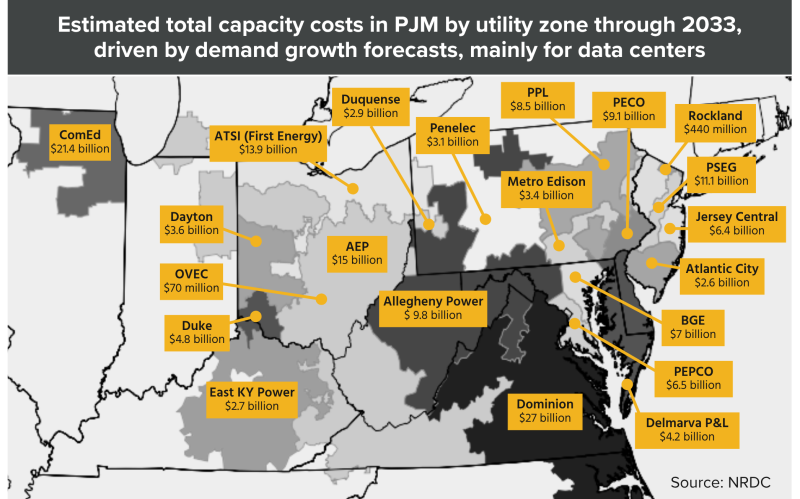
A new analysis by NRDC found that data center growth could result in a total of $163 billion in cumulative capacity costs from 2028 through 2033–including $21.4 billion for ComEd territory in northern Illinois. That translates to a $70-per-month increase for the average household. Click the image to read a fact sheet.
Record new demand from data centers is driving up energy costs and concerns about reliable power supply. Preliminary utility forecasts in PJM Interconnection, the largest power grid operator in the country, show that data centers could require more than 50 gigawatts of peak electricity capacity by 2030 — enough to power more than 20 million households, or approximately all the homes in New Jersey, Pennsylvania, Ohio, Virginia, and Maryland combined.
At a media briefing hosted by Consumers for a Better Grid on October 22, experts from the Citizens Utility Board of Illinois and the Natural Resources Defense Council (NRDC) provided context for what is at stake for consumers and grid reliability if skyrocketing data center energy demand isn’t addressed, and provided potential solutions that put consumers first.
The panelists noted that electricity demand from proposed data centers is the primary reason for recent electricity bill spikes for residents living in PJM states, according to PJM’s Independent Market Monitor. Steeply increasing forecast data center growth was responsible for $9.3 billion of a $14 billion regional capacity bill in 2025/26, and hitting the higher market cap starting in the summer of 2028 will result in a total of $163 billion cumulatively in capacity costs through 2033 (including $21.4 billion for ComEd territory in northern Illinois). That translates to a $70-per-month increase for the average household, according to NRDC. (See this fact sheet for more details.)
PJM is currently evaluating options to address this new load demand in a process called the Critical Issue Fast Path (CIFP). Any decisions made during this process will have huge ramifications on consumers—from the price of electricity, to how to deal with who doesn’t get electricity supply during times of high demand, to what types of new energy sources are added or fast-tracked for development.
PJM’s current proposal does not require data centers to reduce energy consumption during peak demand times, which could lead to rolling blackouts. PJM is also proposing a 10-month fast track for new resources, meaning these projects will effectively “jump” the Interconnection Queue, which primarily comprises clean energy projects that have been waiting over five years for approval.
A better approach, as noted by Consumers for a Better Grid, would require data centers to cover their own costs and bring their own capacity, utilize energy efficiency and demand flexibility, and improve load forecasting to prevent overpaying.
Speakers included Claire Lang-Ree, Advocate for the Sustainable FERC Project, Natural Resources Defense Council and Clara Summers, Consumers for a Better Grid Campaign Manager, Citizens Utility Board of Illinois.
Quotes from speakers:
Claire Lang-Ree, Advocate for the Sustainable FERC Project, Natural Resources Defense Council:
“Average utility bills have already increased by $20 to $30 due to the price increase that we saw in the last auction, and this problem will just get worse through the coming decade if nothing is done. We’re estimating that average bills could increase by another $70 per month.”
“It’s hard to overstate what’s at stake here. The basic problem in PJM is that projected demand is outpacing supply.”
“When we talk about reliability, sometimes it can be difficult to understand, does that mean blackouts? Does that mean high scarcity pricing periods? The answer is that it’s all of the above.”
“The amount of money PJM residents will pay for old power plants is about as much as it would cost to build brand-new zero-emission electricity and storage to power data centers.”
Clara Summers, Consumers for a Better Grid Campaign Manager, Citizens Utility Board of Illinois:
“Unless something is done, everyday people will be left holding the check for some of the wealthiest companies in the world, and that’s unacceptable.”
“If data centers are allowed to contract with existing generation to serve their demands specifically, that means that there’s less available capacity for the rest of us, and prices go up even more.”
“If the question is, ‘Which resource is the fastest to build,’ the answer is ‘Not gas.’ It’s actually battery storage.”
“This is a billion-dollar issue that we need to address…There are ways to reliably and affordably integrate new demand from data centers, but they have to be good grid citizens. Since these are some of the wealthiest companies in the world, they should be able and willing to carry their costs.”