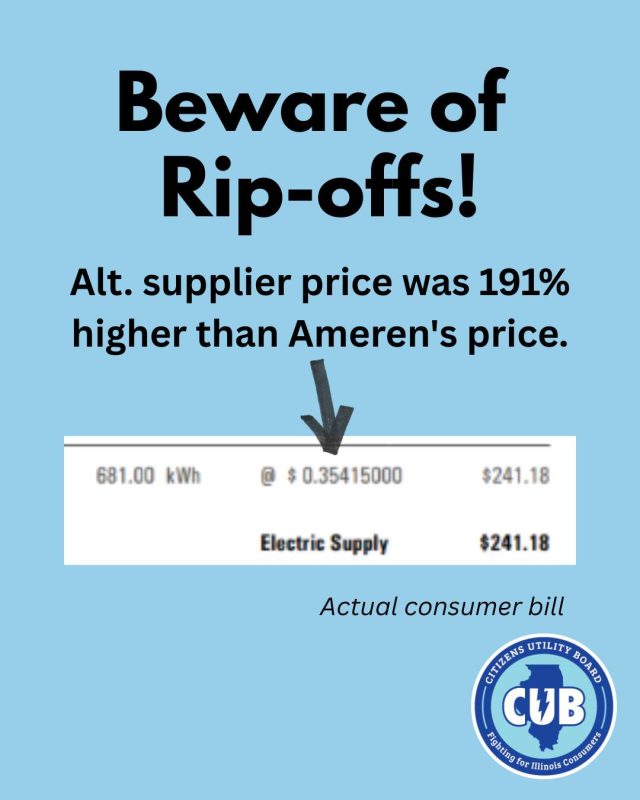
A consumer contacted CUB frustrated that an alternative supplier was charging them a rate that was about 191% higher than Ameren’s utility supply price at the time. Beware of bad deals!
In a year when electricity prices have been high, you may get targeted advertisements or offers in the mail tempting you to switch to an alternative supplier. But remember that alternative electricity suppliers are often impacted by the same market conditions that cause utility prices to go up. Be careful about getting lured into bad deals.
CUB urges consumers to review the “Supply” section of their power bills to confirm they are not overpaying with an expensive alternative supplier offer, including ”municipal aggregation” offers negotiated by local governments. It’s important to know your utility’s “price to compare,” which is the price you compare to alternative supplier offers:
- ComEd’s power price (from October 2025 through May 2026):
- 9.689¢ per kilowatt-hour (kWh) (Appears as 0.09689 on bills.)
- This price includes the supply price plus a transmission charge.
- Ameren’s power price (from October 2025 through May 2026):
-
- 8.402¢ per kilowatt-hour (kWh) for up to 800 kWh of usage. (Appears as 0.08402 on your bill.)
- 7.483¢ per kWh for electricity usage beyond 800 kWh. (Appears as 0.07483 on your bill.)
- These include the supply price plus a transmission charge plus a supply cost adjustment.
- IMPORTANT: Ameren’s price is +30% lower than what it was this past summer.
If an alternative supplier promises savings, don’t take their word for it. Compare the price they quote you to your utility’s supply prices listed above. (The current price to compare for your utility also should be listed on your electric bill, and can be found on CUB’s Electric page and at plugin.illinois.gov.)
While many customers may want the opportunity to shop around, there are a lot of pitfalls. A CUB review of state electricity choice reports found that Illinois consumers have lost more than $2 billion to alternative electricity suppliers over the last decade. An alternative supplier may offer a low introductory rate that will skyrocket after a short period. (Ask how long a rate lasts, and what the new rate will be after the introductory period.) Also, be wary of add-on fees that can raise the cost of the plan. If a supplier offers a lower fixed supply price, scan the fine print for a ”force majeure” clause that allows the company to back out of the deal. (It’s happened before during high-priced times.)
You could be on a “municipal aggregation” deal. (Check this state resource to see if your community has a power deal.) Municipal aggregation is when community leaders negotiate with an alternative supplier to secure an electricity price for all residents who don’t opt out of the offer. But savings aren’t guaranteed, and CUB has received reports of community power deals with high rates. If you’re on a community power deal, confirm the price, how it compares with the utility’s supply rate, and for how long the contract is. You should be able to opt-out of any aggregation offer without paying an exit fee.
CUB’s tips on avoiding bad alternative supplier deals:
- Know the utility supply rate and how it compares to the offer. It is likely the utility supply price is your best bet.
- Make sure the offer is not an introductory rate that ends in a month or two. And if it is, find out when it ends, and what the new rate will be.
- Scan the fine print for hidden monthly fees and red flags. If it’s a low fixed rate, scan the fine print to see if the company allows itself to change the rate during certain market conditions.
- Be careful of multi-year deals. You don’t want to get locked into a long-term deal that goes sour a year or two into it.
- Be wary about giving your bill or your account number to just anybody. An unethical door-to-door sales representative who sees your bill can get your account number and sign you up for an offer without your permission. There’s no need to sign up at your doorstep—high-pressure sales tactics are a red flag.
- If you want to sign up, watch your bill like a hawk. Be prepared to get out of the deal– you should be able to exit with no penalty.
There are other ways to reduce your utility bills than going with an alternative supplier.
- Practice energy efficiency. Simple things like weatherizing windows and doors can help make utility bills more affordable. Don’t take risks that keep your home too hot or too cold. Efficiency is about eliminating waste but keeping your home safe in any weather.
- Consider ComEd Peak Time Savings or Ameren Peak Time Rewards. These programs give you a bill credit if you’re able to reduce your energy usage for a limited number of hours on certain days (typically hot summer afternoons) when electricity demand is highest. Demand-response programs like these give you incentives to reduce energy usage when demand is at its peak—that helps lower overall energy prices. ComEd’s Hourly Pricing and Ameren’s Power Smart Pricing programs are two other demand-response programs that could be right for your household.
- Consider your savings options with solar power. Learn more about rooftop solar and income-qualified solar programs. If solar panels aren’t possible at your home, consider a community solar deal to help ease costs. Currently, community solar offers guarantee savings compared to the utility’s supply price. But be a careful shopper: Get more information at CUB’s special website, SolarInTheCommunity.com.
If you’re struggling to afford your bills, learn about energy assistance. Income-qualified consumers can apply for the Low Income Home Energy Assistance Program (LIHEAP). To learn more about LIHEAP and if you qualify, visit this page at the Illinois Department of Commerce and Economic Opportunity website or call the assistance line at 1-833-711-0374. (Read our step-by-step guide to applying for LIHEAP.)
Also, stay in contact with your utility company. If you’re struggling to pay bills, call your utility to inquire about energy efficiency programs as well as payment options that give you a longer time to pay off debt.