By Clara Summers
Manager, CUB’s Consumers for a Better Grid Campaign
You may have seen a flurry of news about electric bill increases due to something called a “capacity auction.” Or worse, you opened your June ComEd bill and saw a sharp uptick. You can learn more about PJM’s capacity market and this year’s price spike in our previous blog, and by visiting our Help Center.
Sadly, there’s more bad news. Prices are going up yet again–next June. Let’s break it down.
So what’s happening to ComEd bills?
The price spike we are experiencing now was set in stone last July. That’s when PJM held its auction for 2025/2026 to determine what we pay for reserve electricity, or capacity. It was bad enough when prices reached record highs for that auction, but PJM just set another record for its 2026/2027 auction, which will go into effect on June 1, 2026. The auction price jumped 22 percent, increasing from $269.92 per Megawatt-day to $329.17 per MW-day. 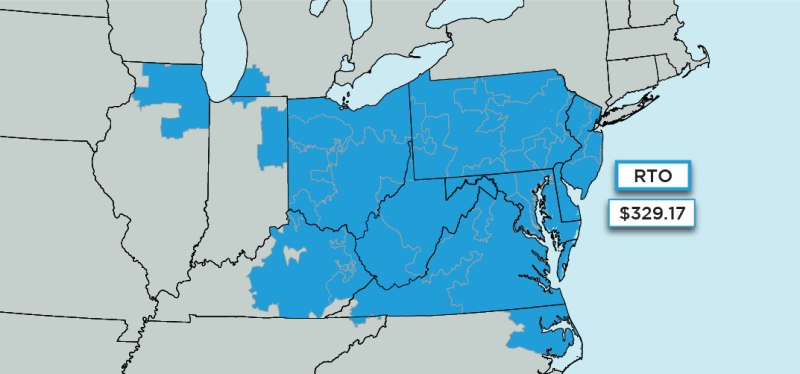
That doesn’t mean your bill will go up 22 percent–capacity is only one component of ComEd’s supply price for electricity–but it does mean your bill will increase.* ComEd initially said bills will go up by about 2 percent next year–on top of the spike consumers are feeling now–but we won’t know final estimates until sometime next May.
Did anything change since the last auction?
After last year’s devastating auction results, advocates sprung into action. Environmental organizations filed a complaint at the Federal Energy Regulatory Commission (FERC) about how PJM made ratepayers pay extra for otherwise retiring coal plants, but then ignored them in the capacity auction, falsely reducing supply. Consumer advocates supported that complaint and added our own, where we argued, among other things, that PJM wasn’t counting the contribution of many renewables either. PJM changed its rules for the better in response to these complaints.
Gov. Shapiro of Pennsylvania also brought a complaint to FERC, saying that the normal price cap of $500 per MW-day should be lowered until the interconnection queue starts working again. (Remember, a major factor for these high prices is PJM’s interconnection queue delay). PJM and Gov. Shapiro agreed on a regional price cap of $329.17 per MW-day for the next two auctions. While there were other parts of the agreement that raised consumer advocate concerns, we supported the price cap.
The most recent auction, setting prices that will take effect next June, hit the price cap negotiated by Gov. Shapiro. PJM did an analysis of what the clearing price would have been without the new price cap, and holding all else equal, the price cap saved consumers an estimated $2.9 billion. As a consumer advocate, we are relieved that there was a price cap that protected ratepayers from even worse outcomes, but are still frustrated that we got here in the first place.
Why is the capacity price going up even more?
Significant increases in demand, combined with a restriction in supply (the frozen interconnection queue), cause prices to go high.
The biggest contributor to the price spike in this auction was large loads, such as data centers. They accounted for approximately 4.9 GW of demand increase. Large loads are not synonymous with data centers–they can include facilities for producing steel and computer chips, for example, which also represented large loads coming into this auction. But the vast majority of the very largest loads were data centers.
It seems unfair for my electric bill to cost more because of data centers. Are there ways to make them pay their fair share?
Because data centers are such a major driver of the cost increase, it is critical that policymakers find fair ways to assign those costs, instead of making all consumers pay for them. Fortunately, this is a resolvable problem. PJM and states both have a role in finding solutions.
- PJM needs to improve its load forecasting so only the big data centers that we are confident will materialize are reflected (more about that here). Consumers should not be paying extra in capacity prices for data centers that developers might build but don’t. Secondly, PJM should explore creating an interconnection queue for large loads. This would ensure that the grid is ready for them to connect and that there is enough generation to go around before they do so. Data centers could even connect to the grid by acting as flexible load, reducing operations when electricity is in high demand to spare the grid.
- There is also a clear role for states in helping large loads to be good grid citizens. One is that states can require data centers to operate with a certain level of energy efficiency or load flexibility. States should also create separate rate classes for data centers, so costs of local utilities infrastructure upgrades to serve data centers don’t fall unfairly on everyone else. Also, states can require data centers to bring their own new generation with them.
There are ways to reliably and affordably integrate new demand from data centers, but they have to be good grid citizens. Since these are some of the wealthiest companies in the world, they should be able and willing to carry their costs. PJM and our state policymakers have the power to ensure that. (Read our related blog: How data centers are raising our bills in Illinois–and what we should do about it.)
As an Illinois consumer advocate, CUB also sees the proposed Clean and Reliable Grid Affordability (CRGA) Act as a vital state reform. Among other things, the CRGA Act would add battery storage to the system to store energy when it’s cheapest and put it back on the system when demand is highest, helping to bring prices down, and the legislation would promote wise resource planning. Both are necessities if we want to solve our capacity problems.
*Some areas of PJM will see a price reduction compared to the last auction. These are customers in the BGE utilities zone in Maryland and the Dominion utilities zone in Virginia and North Carolina. This, however, is only because their prices last year were astronomical—well over $400 MW/day.
 About the Author:
Clara Summers joined CUB in 2023. She heads the Consumers for a Better Grid (formerly CLEAR RTO) campaign, which advocates for a cleaner, more affordable power grid for the 65 million people served by PJM, the nation’s largest grid manager. Clara is based in the greater DC area. When not deep in the weeds of energy policy, she enjoys Irish dance, hammered dulcimer, and anything to do with koalas.