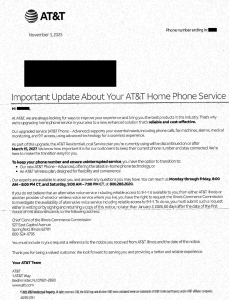
Click on the image to see a larger version of the letter.
AT&T has been mailing letters to customers announcing that it is ending “AT&T Residential Local Service,” its traditional copper landline service, a.k.a. plain old telephone service. Here’s our Q&A on what’s happening:
What do the letters mean?
For over a decade, the telecom giant has been making moves to phase out landline telephone service across the country. These letters represent the latest step in that process.
- One letter, to current customers of AT&T’s traditional landline phone service, informs them that their service will be discontinued “on or after March 15, 2027.”
- Another letter–some people have reported receiving both–informs customers that as of Oct. 15, 2025, traditional landline phone service is no longer being offered to new customers and current customers cannot make changes to their existing service. (This also means current customers who move cannot get a traditional landline when they re-establish service in a new location.)
Can AT&T do this?
Yes, unfortunately. The company has now received approval from state and federal officials to move forward on ending its landline service in Illinois.
For many customers traditional landlines have served as a reliable, affordable connection to family and friends as well as necessities such as 911 service, home security systems and medical monitoring devices. So CUB worked for years to block AT&T from deregulating local phone service. Here’s a brief history:
- AT&T’s earliest attempts to deregulate local phone service began in a case at the Illinois Commerce Commission (ICC) in 2006. That led to a legal settlement between AT&T and CUB that created a series of low-cost, safe-harbor plans branded the “Consumer’s Choice” plans.
- The fight then shifted to the Illinois General Assembly, where, for about a decade, CUB and other consumer advocates stopped AT&T from ending the “carrier of last resort” provision in the Illinois Telecommunications Act. That provision required AT&T to offer landline service to customers in its Illinois territory who wanted it.
- However, in 2017 the General Assembly passed a rewrite of the Telecom Act that gave the green light to end landline service, pending approval from the Federal Communications Commission (FCC). (Note: In 2022, AT&T was fined $23 million by federal authorities for using bribery to pass the 2017 legislation.)
- Also in 2017, AT&T successfully lobbied to end the Telecom Act’s requirement that it offer the low-cost Consumer’s Choice plans. In the years since, AT&T has significantly increased the cost of plain old telephone service, driving more people off landlines.
- This year, the FCC gave final approval to AT&T’s request to discontinue its status of being Carrier of Last Resort in Illinois, leading to the letters sent this fall.
How many customers does this impact?
These developments only impact AT&T landline customers. As of June of 2024, Illinois still had about 552,000 landlines–many, if not most, of those being with AT&T.
What are my options for phone service if I lose my landline?
You could replace your service with digital phone service, also called Voice over Internet Protocol (VoIP), through AT&T or another telecom company. You could also opt for cellular (wireless) service and ask to port your number to your cell phone.
What should I know about these phone options?
- The big difference between digital phone service and plain old telephone service is that calls travel over the Internet, instead of traditional phone lines. That means this service requires a broadband internet connection–and it also means without a battery backup digital phone service does not work when your electricity is down–or during an internet service outage.
- Wireless and digital services use Enhanced 911 service, or E911. While the technology is improving, there are some emergency instances–such as if you cannot verbally communicate your location–that E911 may have difficulty pinpointing your exact location. In the case of digital phone service, ask your provider if you need to register your current address to ensure emergency services can locate your home.
- With digital phone service, you may be able to keep your current phone and phone number.
Here’s a checklist of questions to ask about digital phone service options:
- Is the price you’re offering an introductory rate that goes up after a certain time?
- Can I use the service with my current phone?
- Can I keep my current phone number?
- Does the service work with other services, such as a fax machine, security systems, a pacemaker, or other medical-monitoring devices?
- Does the service offer a battery backup in case there’s a power outage?
What are options with AT&T?
AT&T’s letters list alternatives to its Residential Local Service: the company’s wireless service and two digital voice plans, AT&T Phone or AT&T Phone-Advanced (AP-A). AT&T Phone and Phone-Advanced cost roughly $35-$50 or more a month–plus a one-time fee for the equipment. The fee was listed as $189, but AT&T at one point was offering the equipment at a deep discount: For only $1. However, the company said that the $1 equipment charge offer was “subject to change and may be discontinued at any time.” There’s a do-it-yourself installation kit, but you can also choose for an AT&T technician to install the equipment, at an extra cost.
- AT&T Phone: Price range of about $35 to $45 a month, but always confirm the price and ask if it’s an introductory rate that ends.
-
- Requires an internet connection through AT&T, at an additional cost, either separately or as part of a bundled package.
- Allows you to keep your current phone number and your current phone (except rotary or pulse phones).
- Includes unlimited local and long-distance calling in the United States and to Canada, Mexico, Puerto Rico, the U.S. Virgin Islands, Guam, and the Northern Marianas. (Calls to additional countries will cost extra.)
- Includes multiple services, such as voice mail, call forwarding, caller ID, call waiting and three-way calling.
- Works with most security and medical monitoring systems.
- AT&T Phone – Advanced (AP–A): Price range of about $45 to $50, but always confirm the price and ask if it’s an introductory rate that ends after a certain period.
-
- AT&T says this phone service can work through its cellular network, or, if you pay extra, through a broadband internet connection. AT&T recommends placing the phone on the first or second floor near a window or outside wall for the best reception. If you do pay extra for broadband, the phone service will continue to work through that connection if the cellular network is unavailable.
- Allows you to keep your current phone number and connect up to six devices–including your current phones (except rotary or pulse phones), fax machines, medical devices and security systems.
- Includes unlimited local and long-distance calling (international calls require an extra monthly fee).
- Includes multiple services, such as voice mail, call forwarding, caller ID, call waiting and three-way calling.
- Has a 24-hour battery backup. (Additional batteries cost extra.) The battery backup only helps with a standard corded phone that doesn’t require an external power source. For example, the battery won’t help a cordless phone, and it won’t help with other equipment, such as a Wi-Fi gateway or a modem–those will require separate backup batteries.
Note: The AT&T plans offer a do-it-yourself installation kit, but you can choose for it to be installed by an AT&T technician at an extra cost.
Is there a new service or connection fee?
This is a good detail to confirm with the company. The AT&T Phone – Advanced does not appear have a signup fee associated with it. AT&T Phone plan may have a fee, depending on the broadband options available in your area.
What if my area does not offer a viable alternative for the landline I have now?
If you believe the loss of AT&T’s traditional landline service will leave you without reliable phone service–including access to 911–with AT&T or any other provider, you can ask the Illinois Commerce Commission (ICC) to investigate.
Please submit a request in writing (or, if you received a letter from AT&T, you can sign and return a copy of the letter) no later than Jan. 2, 2026,to:
Chief Clerk of the Illinois Commerce Commission (ICC)
527 East Capitol Avenue
Springfield, Illinois 62701
In your request, make sure to include a reference to the notice you received from AT&T Illinois and the date of the notice. If you have questions, you can call the ICC at 1-800-524-0795.
Note: Please know that the ICC investigation merely has to find that you have one phone alternative in your area.
What if I have questions?
First, call AT&T, at 1-800-288-2020, 8 a.m. – 8 p.m., Monday through Friday, and 9 a.m. – 7 p.m., Saturday. (Also, seniors and customers with disabilities can contact the AT&T Disability and Aging Center, 1-800-772-3140 [TTY calls 1-866-241-6567], for questions about their account. The center is open Monday through Friday, 8 a.m. to 8 p.m., and Saturday 10 a.m. to 7 p.m.)
If you are unable to obtain a response from AT&T, you can call CUB’s Consumer Hotline, 1-800-669-5556, 9 a.m. to 5 p.m., Monday through Friday, and we will do our best to find you the answers.