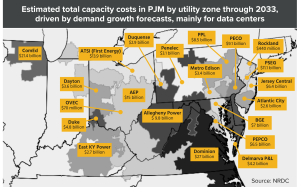
Estimated capacity costs in PJM through 2033 by utility zone. (Click the image to read more.)
What’s happening?
On Wednesday, November 19, PJM members will vote on how to integrate data centers into the grid. As we’ve detailed elsewhere, data centers require massive amounts of electricity and drive up consumer costs. Some, but not all, proposals would ensure that data centers only connect to the electric system if we maintain reliability and affordability.
Who is voting?
PJM has 5 different types of members, Generation Owners, Transmission Owners, Electric Distributors, Other Suppliers, and End Use Customers (big industrial users of electricity and consumer advocates, like CUB).
If you’re noticing how much power big monied interests have, and how little consumers have, you’re not wrong. Do state lawmakers have a vote? No. Does anyone represent the public interest? Only the 14 voting consumer advocate offices.
Big tech companies like Google, Amazon, and Meta are not yet PJM members.
How does the vote work? What are they voting on?
There are 20 proposals! They all fall on a spectrum of doing next-to-nothing to protect reliability and affordability, to actually making data centers take responsibility for themselves.
PJM Members can vote “yes” on multiple proposals. The vote is advisory, which means the PJM Board does not have to follow its results. However, proposals getting a significant amount of votes will certainly attract the PJM Board’s attention.
What are the issues important to consumers?
CUB is evaluating proposals based on the following criteria:
-Require data centers to bring their own new generation or demand response for consistent service. Stealing existing generation doesn’t count.
-…if data centers don’t bring their own generation or demand response, then they are required to act flexibly or be interruptible (can turn them off as needed). Data centers must never cause blackouts for the rest of us.
-Improve the load forecast to make sure that PJM doesn’t double-count speculative data centers.
-Overall, prevent data center capacity, energy, and transmission costs from falling on consumers.
Which proposals meet CUB’s criteria?
CUB has joined in with consumer advocates from Maryland and Pennsylvania on a proposal, called the Joint Consumer Advocates proposal. The proposal protects consumers from high capacity costs, limits energy costs, improves load forecasting, extends the price cap for two years, and starts a new stakeholder process to prevent data centers from increasing our transmission costs. The proposal was carefully developed with consumers at the forefront.
Other proposals that meet CUB’s criteria include proposals by the Independent Market Monitor, the Legislative Collaborative/NRDC, and Silverman/Glatz.
What are the stakes?
Rolling blackouts and spiking bills. If nothing is done, we are looking at an average monthly increase of $70 on our monthly electric bills by 2028. By 2033, it could be $163 billion across all of PJM. That’s unacceptable.
Read our other WatchBlog articles about reining in data center costs:
How data centers are raising our bills in Illinois–and what we should do about it